Streak Doctor
Your GitHub day, live in the terminal — and next, why it didn't count
An open-source GitHub accountability CLI built around one question streak counters ignore: why didn't that contribution count? Today it reports your live count with a countdown to the end of GitHub's UTC day, lists contributions by repo and draws your year as a heatmap in the terminal; the diagnosis engine is next.
Streak tracking is a crowded category. Diagnosis isn't. GitHub silently drops contributions for many reasons — wrong commit email, a fork, a non-default branch, a UTC boundary — and nothing tells you which.
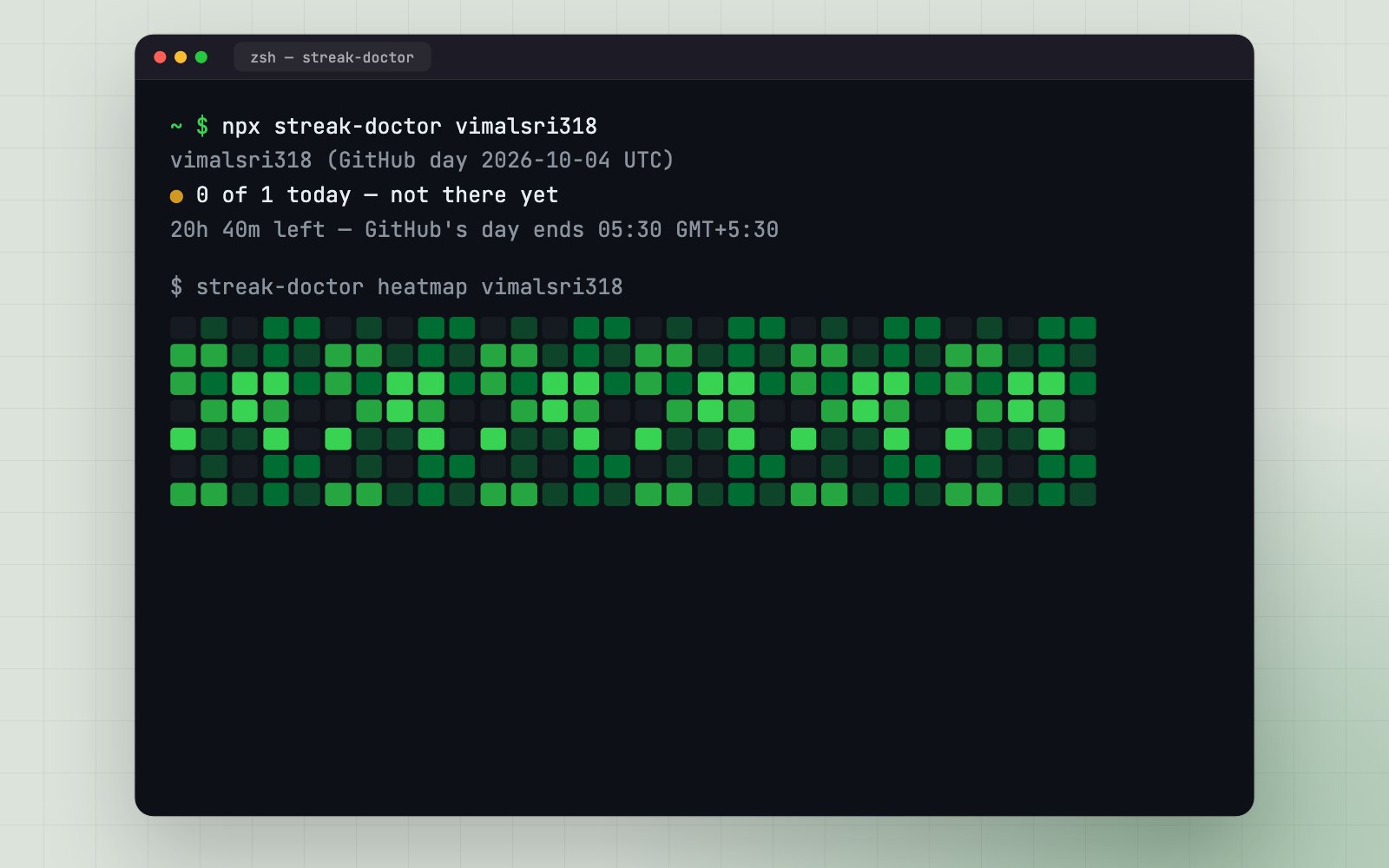
Phase 1 shipped a real CLI on npm that works against the live GitHub API for anyone: today's count and countdown, contributions by repo, and since v0.4.0 a heatmap of the last year drawn in the terminal.
The counting rules are documented in the repo's knowledge base, and a diagnosis engine for the first three causes is the next piece of work, gated on real usage: ship, reach ~200 users, and measure who contributes after an at-risk warning.
GitHub silently drops contributions for half a dozen reasons — an unlinked commit email, a fork, a non-default branch, a UTC day boundary — and the only symptom is a grey square. Streak trackers count; none of them explain.
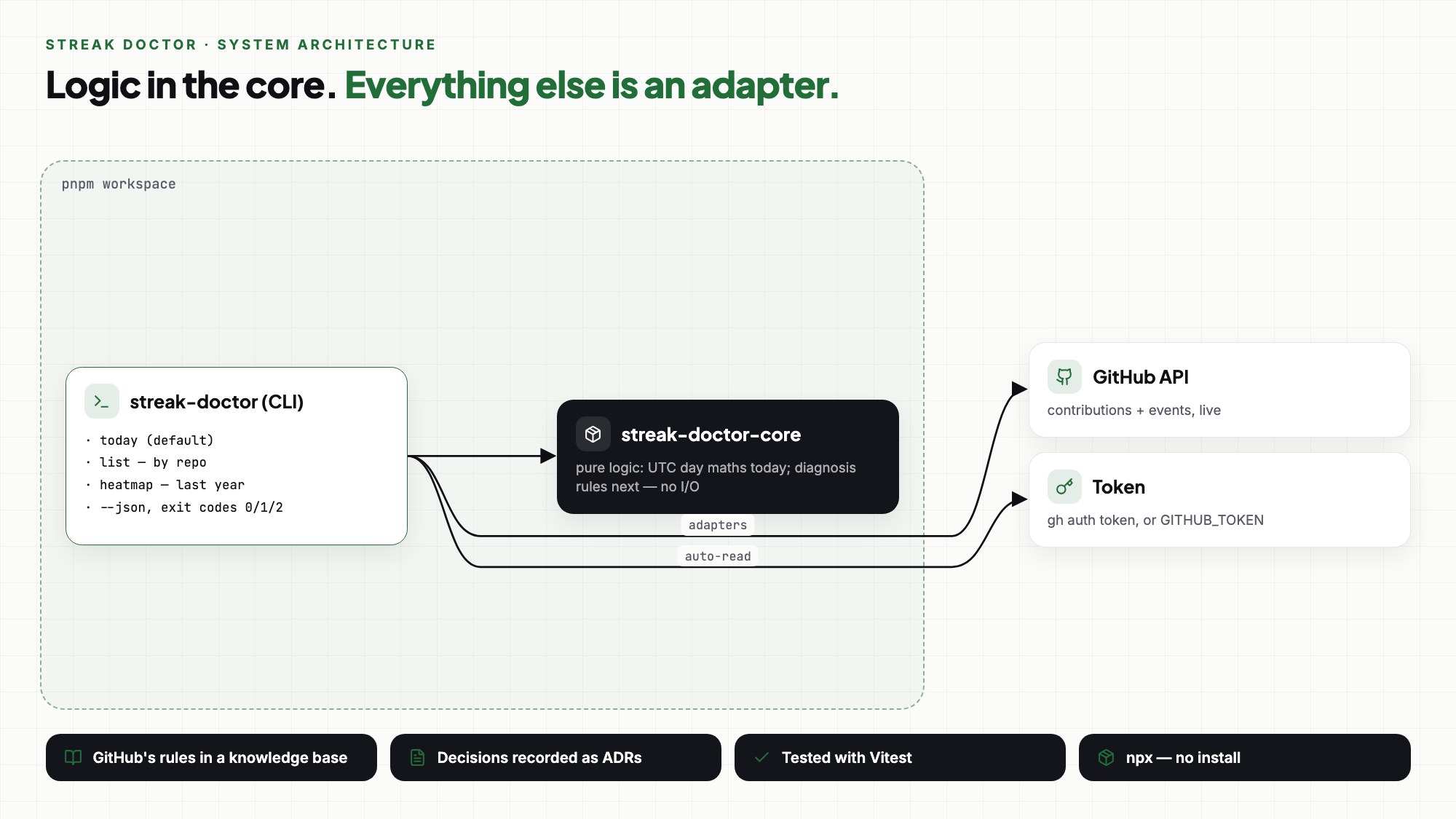
The tool had to be zero-friction: run it once with npx, no install, no sign-up, against the live API.
- 01
Resolve the user
A username argument, or STREAK_DOCTOR_USER; the token comes from gh auth token or GITHUB_TOKEN.
- 02
Fetch live activity
Adapters call the GitHub API for the user's recent contributions and events.
- 03
Apply the rules (next)
The diagnosis engine will check each event against GitHub's documented rules — linked email, default branch, fork, ownership. The rules are written; the engine is next.
- 04
Mind the day
GitHub's day is UTC; the countdown and 'today' are computed for the user's own time zone.
- 05
Report
Human output by default, --json with a versioned schema, and exit codes for scripts.
Live today count
How many contributions have counted and how long is left before GitHub's UTC day ends, in your own time zone.
Terminal heatmap
streak-doctor heatmap draws the last year's contribution grid in characters.
Zero install
npx streak-doctor <username> works for anyone; it reuses the gh CLI token if you're logged in.
Core + CLI packages
Logic lives in a separate core package with no I/O, ready for other front ends.
A wedge, not a feature list
Streak counting is a crowded category; explaining why a contribution didn't count isn't. Everything in v1 serves that one question.
Core without I/O
Diagnosis lives in streak-doctor-core with no network or filesystem access, so it's easy to test and ready for other front ends.
Write the platform's rules down
GitHub's non-obvious counting and timezone rules live in a knowledge base, so fixes don't depend on someone remembering them.
Zero friction
Published to npm and runnable with npx; it reuses the gh CLI's token when you're already logged in.
- →Diagnosis engine v0 for the first three causes: unlinked email, non-default branch, fork.
- →A real auth story for the CLI (device flow or PAT) instead of borrowing gh's token.
- →Streak arithmetic, then watch / daemon notifications that warn before the day ends.
- →Phase gate: ~200 users; continue if 30%+ contribute after an at-risk warning, stop below 10%.
Want something like this?
I can build one for you.
Tell me what you have in mind — I'll reply with questions, a plan and a quote.