Influnet
Find real creators. Run every collab to the finish.
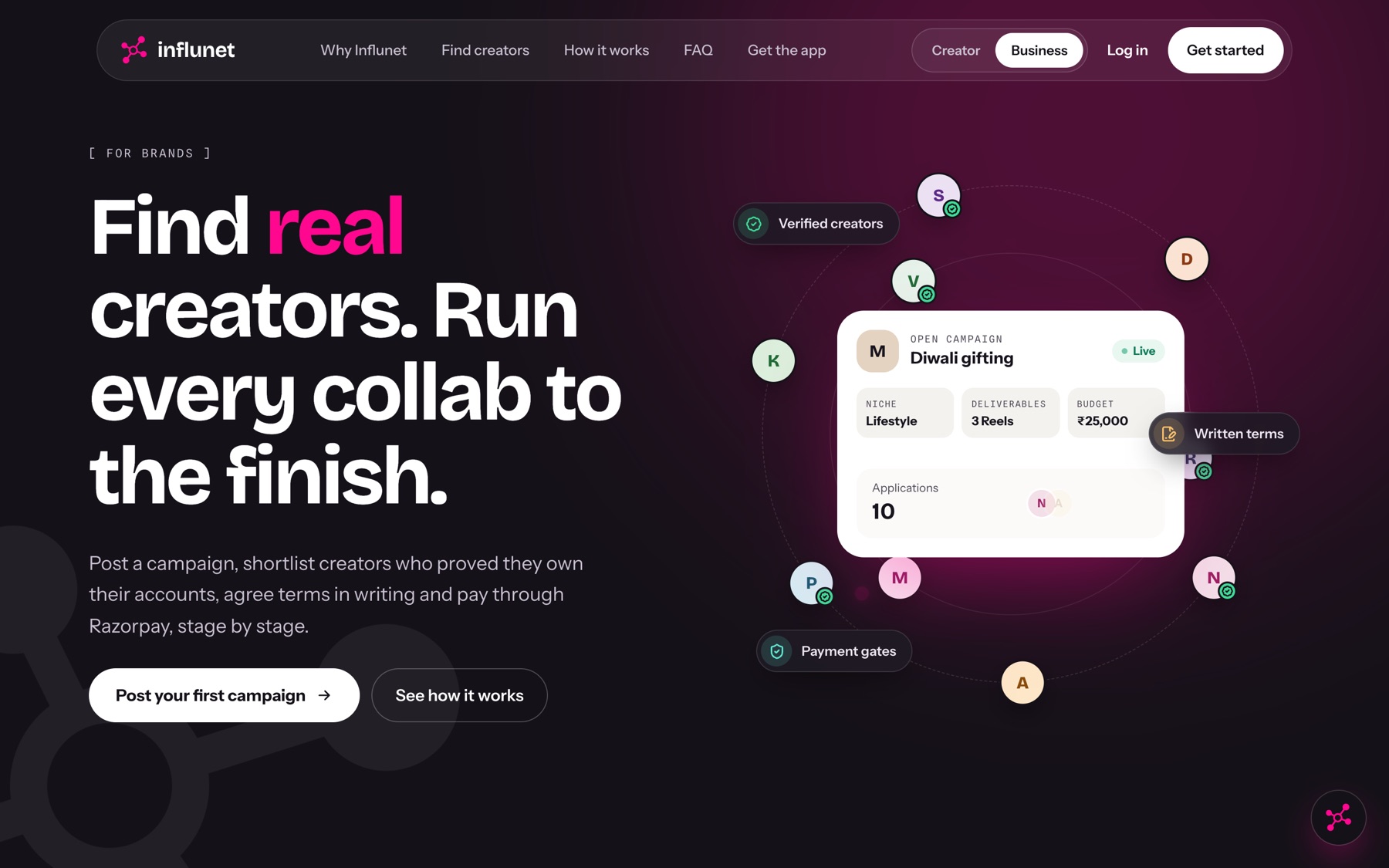
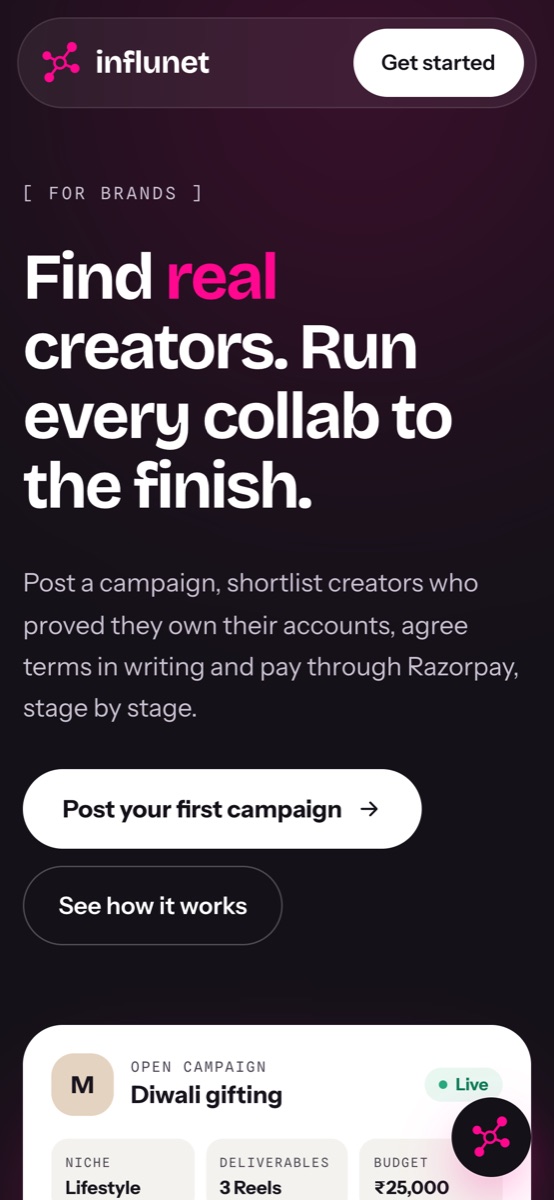
An influencer-marketing platform where brands post campaigns, shortlist creators who have proved they own their accounts, agree terms in writing and pay stage by stage — on the web and in a native mobile app.
Creators and brands mostly meet in Instagram DMs and email threads, where replies take hours or days and deals fall through. Influnet replaces that with one link: a creator puts their Influnet profile in their bio, a brand taps it, and a collaboration request lands instantly.
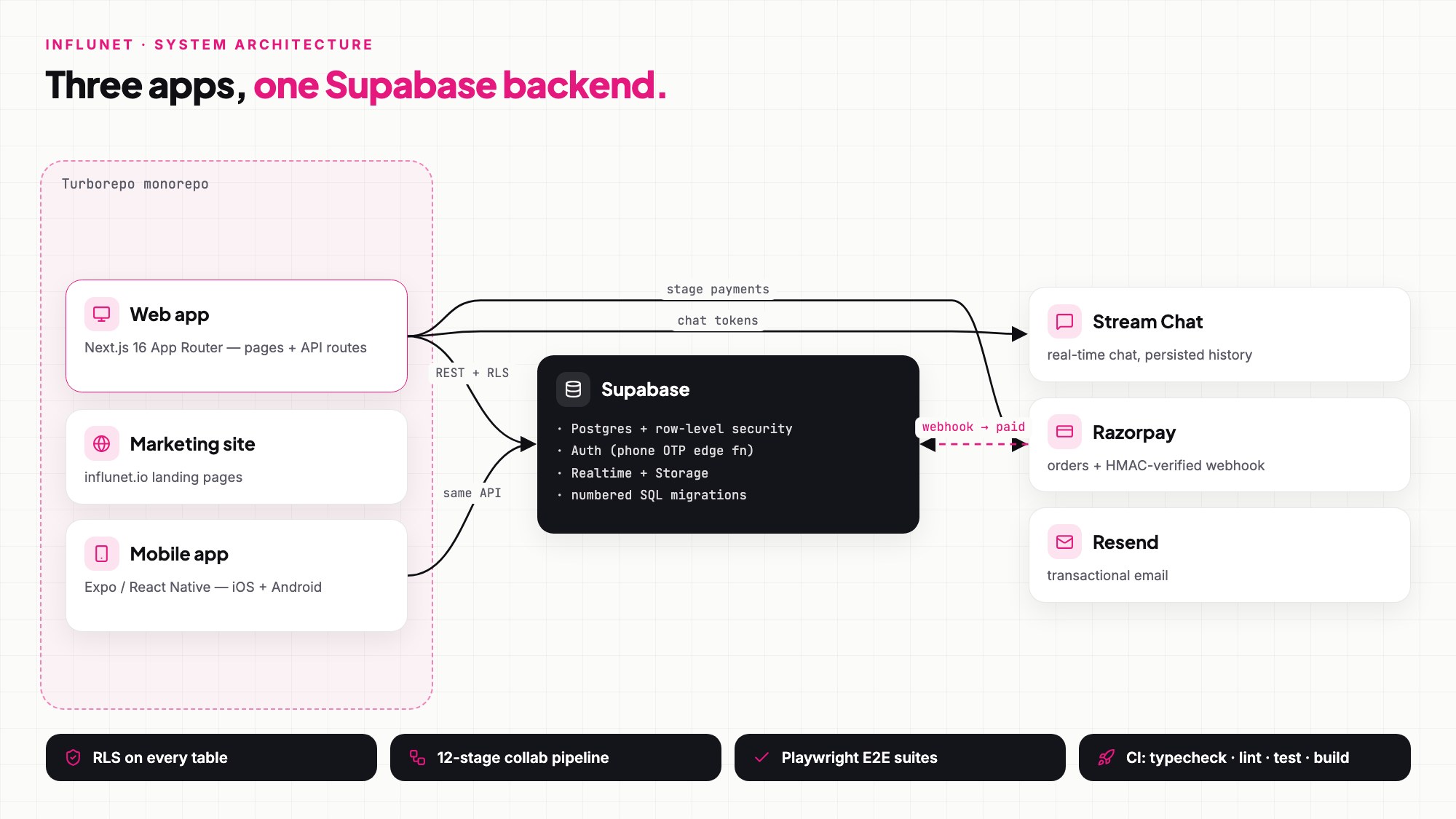
I built it as a Turborepo monorepo — a Next.js 16 web app with its API routes, a separate marketing site, and an Expo / React Native app for iOS and Android — on top of Supabase for auth, Postgres and row-level security.
Every collaboration moves through a 12-stage pipeline with a Kanban workspace, real-time chat on Stream, written terms and Razorpay payment gates, with an admin approval flow on top.
Creators and brands mostly meet in Instagram DMs and email threads. Replies take hours or days, follower counts are easy to fake, and the terms of a deal live in someone's chat history — so collaborations stall or fall apart halfway.
Brands needed to know who they were actually talking to before they replied. Creators needed one place for every deal, and both sides needed a shared record of what was agreed and what had been paid.
- 01
Prove it's you
Creators verify they own their social accounts. Unverified profiles show a neutral 'ownership not verified' label, and a business sees a warning before sending a request.
- 02
Request
A brand finds a creator through search or their link-in-bio profile and sends a collaboration request, which lands as an in-app notification.
- 03
Agree in writing
Accepting a request opens a project and a Stream chat. Terms, deliverables and budget are discussed and recorded inside the project.
- 04
Work the pipeline
The project moves through 12 stages — deposit, planning, shooting, editing, review, revisions, approval — with a 'whose turn' owner on each stage.
- 05
Get paid
Advance and final payments go through Razorpay. Only the signature-verified webhook can mark a payment as paid; the client never self-reports it.
Verified creator profiles
Creators prove they own their social accounts before brands can shortlist them, with live follower, view and engagement stats on a shareable link-in-bio page.
12-stage campaign pipeline
Every collab moves from request to brief, terms, content, approval and payout on a Kanban workspace both sides can see.
Chat and notifications
Stream-powered chat with persisted history and an in-app notification bell, so requests get answered in minutes instead of days.
Payment gates
Razorpay payments are released stage by stage against agreed deliverables, with written terms attached to every deal.
- 01Turborepo monorepo: Next.js web app, marketing site and Expo mobile app sharing one backend
- 02Supabase Postgres with row-level security and a documented PII lockdown
- 03End-to-end Playwright suites covering requests, chat, freemium limits and access guards
- 04Phone OTP sign-in through a Supabase edge function
Keep the stack, buy at the service level
No marketplace framework. Next.js and Supabase stay the core, and chat, payments and email are bought as services (Stream, Razorpay, Resend) instead of being rebuilt.
One app, scaled horizontally
The web app and its API routes deploy as one unit. When background work grows, the plan is to split out a worker — not to split frontend from backend.
The database enforces the rules
Row-level security decides who can read and write each table, and a documented PII lockdown keeps private fields out of public profiles. A bug in the UI can't leak data on its own.
Payments the client can't fake
Razorpay orders are created on the server and a signature-verified webhook is the only writer of 'paid'. Stage gates check that record, not anything the browser says.
- →Reviews and ratings on completed projects, written once per side and enforced by row-level security.
- →A completed-work showcase on each creator's public profile, feeding rating and completed count into discovery.
- →Per-project progress bars and a 'whose turn' label on both dashboards.
- →Admin-controlled runtime settings, agreed in principle and deferred until they're needed.
Want something like this?
I can build one for you.
Tell me what you have in mind — I'll reply with questions, a plan and a quote.