Email Finder
Finds a work email — and tells you how much to trust it
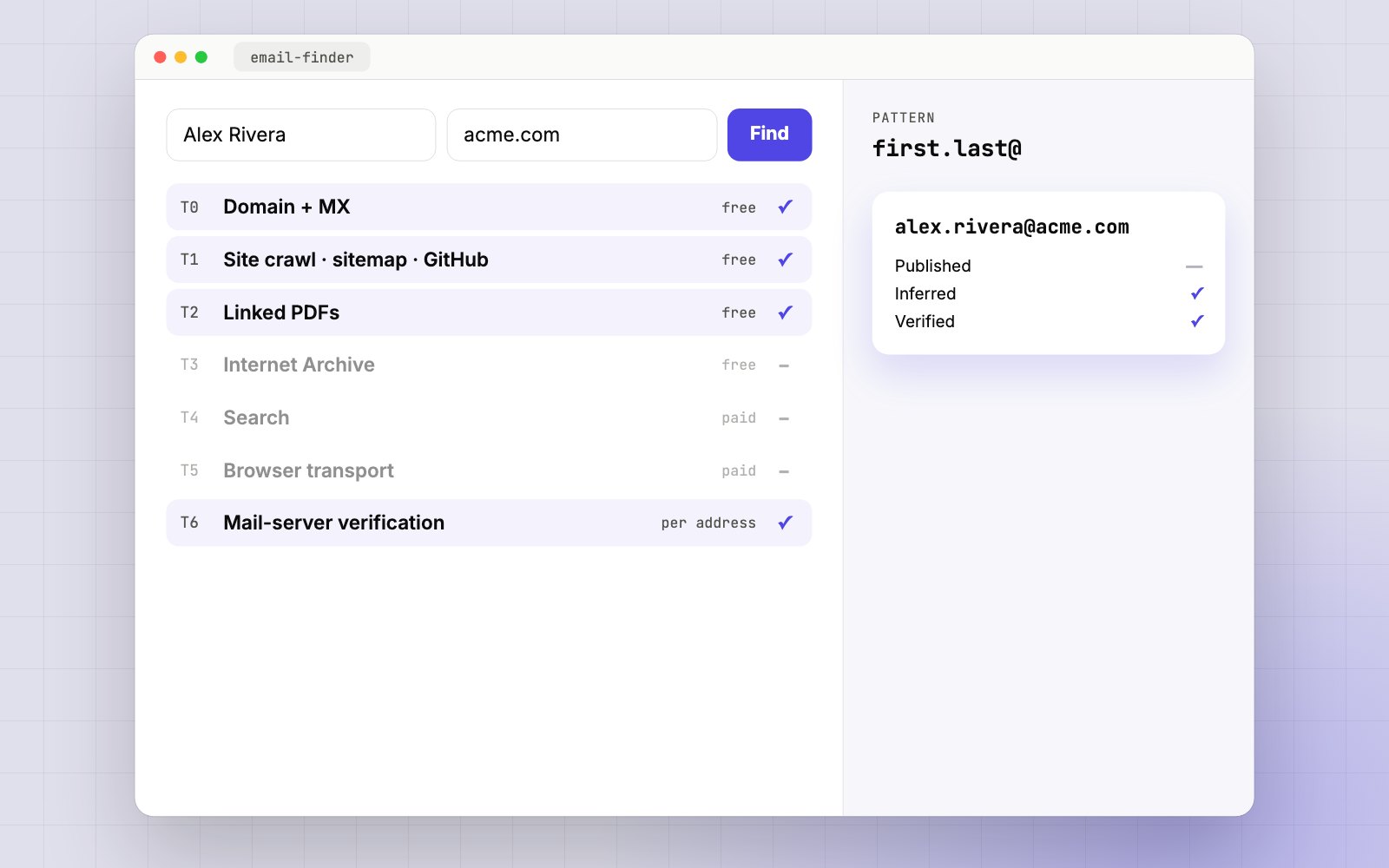
Give it a name and a company website; it gathers evidence across seven tiers — free ones first — infers the domain’s email pattern, and only reports an address as certain as the evidence allows.
Engineer — crawling, inference & verification
- Background workers
2026
Private build — demo on request
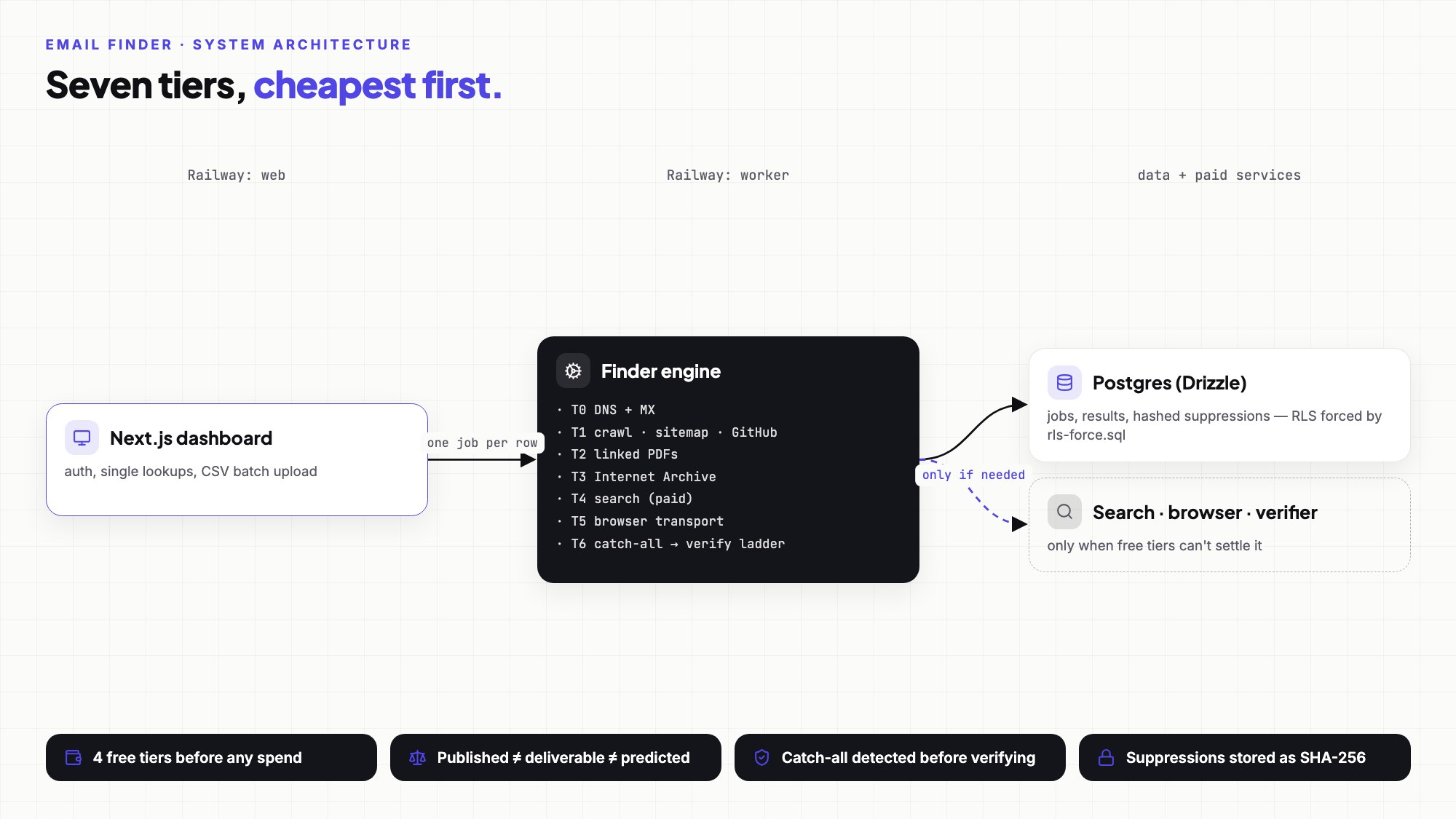
Most email finders guess a pattern and hope. This engine gathers evidence and weighs it: DNS and MX records, a relevance-scored site crawl, sitemaps, GitHub commit authors, linked PDFs like staff directories, and the Internet Archive for blocked sites.
Paid tiers — search queries, a browser transport for JavaScript-heavy or firewalled pages, and mail-server verification — only run when the free tiers cannot settle the question.
Results keep three claims separate on purpose: published, inferred and verified, because each one fails in a different way. It runs as a web app plus a background worker on Railway.
Sales teams need a person's work email, and most tools answer by guessing a pattern (first.last@) and labelling it 'verified'. On catch-all domains that label is meaningless, and every bounce hurts the sender's reputation.
The goal was a finder that spends as little as possible per lookup and is honest about certainty — including saying 'don't mail this person here' when the evidence says so.
- Background workers
- 01
Resolve the domain
DNS and MX first — free, and enough to rule out domains that can't receive mail at all.
- 02
Gather free evidence
A relevance-scored crawl, sitemaps, GitHub commit authors, linked PDFs like staff directories, and the Internet Archive for sites that block crawlers.
- 03
Infer the pattern
Name/address pairs found along the way teach the domain's format; the engine ranks a candidate ladder from it.
- 04
Spend only if needed
Search, a browser transport for WAF-blocked or JS-rendered pages, and verification run only when the free tiers can't settle it.
- 05
Verify honestly
Catch-all detection runs before the ladder; a verified rejection of every candidate returns fail — a useful 'don't mail' rather than a guess.
Seven evidence tiers
Free sources first; paid search, browser and verification only when needed — costs stay predictable.
Pattern inference
Learns the domain’s email format from any name/address pairs it finds, then ranks a candidate ladder.
Honest confidence
Published, inferred and verified are reported separately — never more certain than the evidence.
Catch-all detection
Detects domains that accept every address before trusting a mail-server “yes”.
- 01Web app and worker deployed as separate Railway services
- 02Worker waits for the database instead of crashing on cold starts
- 03Drizzle migrations with separate local and production configs
- 04Unit-tested inference with Vitest
Three claims, never merged
Published, deliverable and predicted fail differently, so they're reported separately. Only published and deliverable together earns 'confirmed'.
Cheapest evidence first
Four free tiers run before any paid search, browser or verification call, keeping per-lookup cost predictable.
Don't trust the ORM's RLS
Querying pg_policies showed drizzle-kit pushing policies with no USING clause — RLS on, but every row visible. The real predicates live in rls-force.sql, re-run after every push.
A worker that waits
Web and worker deploy as separate Railway services; the worker waits for the database on cold starts instead of crash-looping.
- →Wire in a production verification provider so more results can reach 'confirmed'.
- →Self-hosted browser transport to keep tier 5 costs flat.
- →Per-lookup cost reporting in the dashboard.
Want something like this?
I can build one for you.
Tell me what you have in mind — I'll reply with questions, a plan and a quote.